Published: 13th June 2026
Most PPC accounts do not fail because the ads are bad. They fail because each channel is chasing its own metric, its own audience and its own version of success. Meta is driving clicks, Google is harvesting branded demand, Amazon is cleaning up the sale, and nobody is managing the system as a whole. That is exactly why a full funnel PPC guide matters for ecommerce brands trying to scale without wasting budget.
If you sell through Amazon, your own site, or both, full funnel PPC is not about being present on more platforms. It is about assigning each platform a job inside one commercial plan. Done properly, it reduces overlap, improves conversion efficiency and gives you a cleaner path from first impression to repeat purchase.
A useful full funnel PPC guide should not just explain awareness, consideration and conversion like a marketing textbook. You already know the theory. What you need is an operating model for paid media that connects demand creation, demand capture and demand conversion.
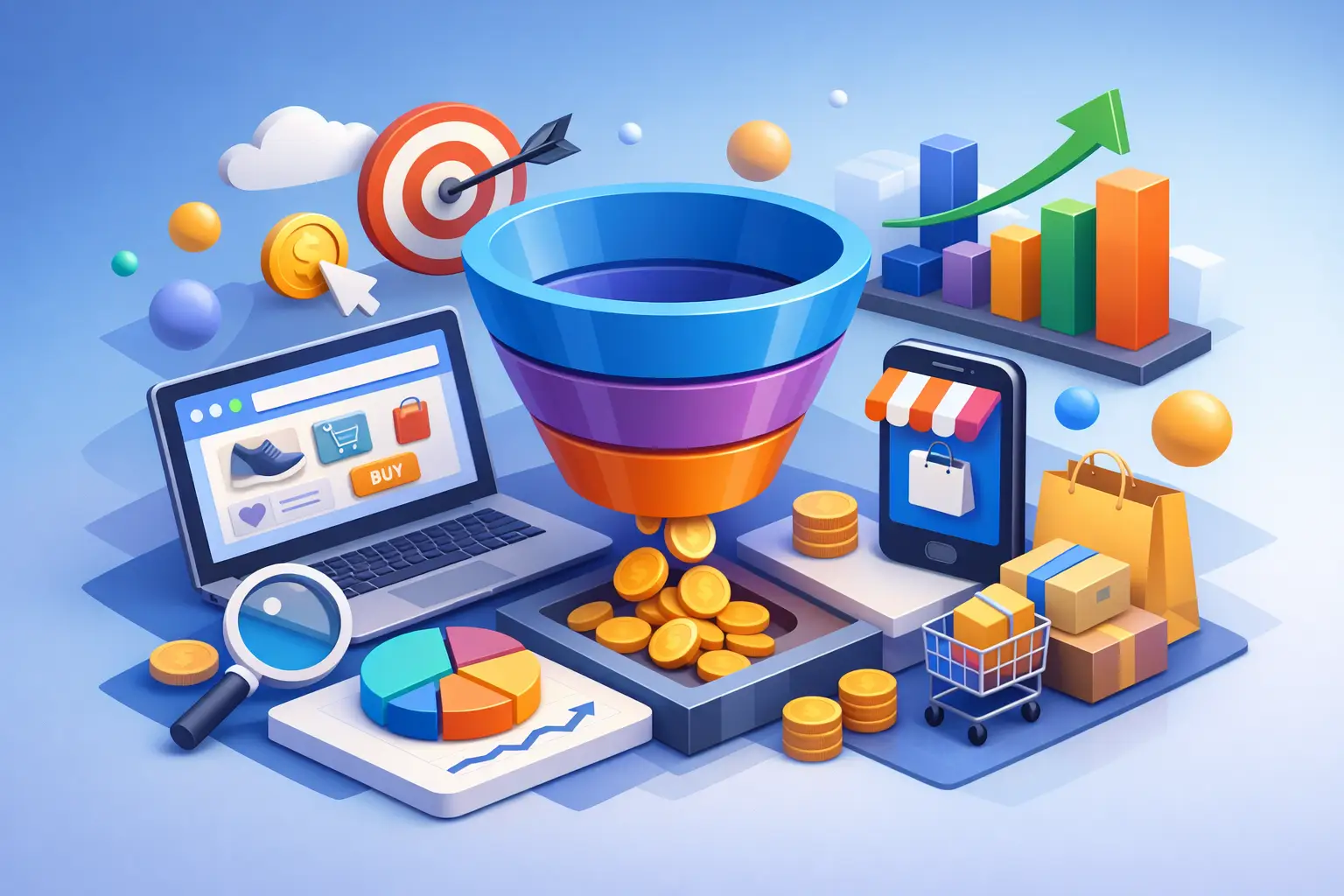
At the top of funnel, channels such as Meta, TikTok and YouTube are there to generate attention and create future demand. In the middle, Google Search, Shopping and remarketing help convert active interest into traffic with intent. At the bottom, branded search, Amazon Sponsored Products, remarketing and offer-led campaigns help turn high-intent users into revenue.
The mistake most brands make is treating these stages as separate campaigns run by separate people. That creates duplication, inflated acquisition costs and weak forecasting. A full funnel strategy fixes that by deciding where demand starts, where it is captured and where it closes.
The cleanest way to structure a funnel is not by platform but by intent.
If your entire paid strategy depends on users already knowing what they want, growth will eventually stall. Search demand is finite. Competitors can bid against it. CPCs rise, margin gets squeezed and scaling becomes harder every quarter.
Top-of-funnel activity exists to widen the pool. On Meta and TikTok, that usually means prospecting campaigns built around audience discovery, creative testing and product-market fit signals. On YouTube, it may mean product education, founder-led messaging or category problem-solution content.
The key trade-off is efficiency versus scale. Top-of-funnel traffic rarely looks efficient on last-click reporting. That does not make it unprofitable. It means you need to judge it on assisted revenue, branded search lift, view-through impact and downstream conversion rates. Brands that cut top-of-funnel spend too early often end up paying more for bottom-of-funnel media later.
This is where Google becomes critical. Once awareness activity is working, users start searching category terms, comparing options and looking for validation. Your job in the middle of the funnel is to capture that intent before it leaks to a competitor, a marketplace listing or a review site.
For DTC brands, this often means a mix of non-brand Search, Shopping, Performance Max used with control, and remarketing layers that reflect product interest. For hybrid brands, it may also mean deciding whether the click should go to your site or Amazon, depending on margin, conversion rate, stock position and customer lifetime value.
This is where fragmented PPC management causes real damage. If Meta is generating interest but Google budgets are too restricted to capture it, you lose the compounded effect. If Amazon is seeing a spike in branded searches but nobody connects that back to off-Amazon activity, you underinvest in the channels actually creating demand.
Bottom-of-funnel campaigns are where most brands feel comfortable because the numbers are visible. Branded search converts. Retargeting converts. Amazon Sponsored Products converts. The danger is relying on these campaigns to do more than they can.
High-intent traffic should be protected, but not mistaken for growth. If all your results come from users who were already close to buying, you are harvesting existing demand rather than creating new revenue.
Bottom-of-funnel activity should focus on removing friction. That means sharper offer presentation, better feed quality, stronger product detail pages, cleaner landing pages, more disciplined audience exclusions and tighter messaging continuity. The objective is not just cheaper CPA. It is higher conversion value from intent that has already been paid for upstream.
This is where a standard PPC framework starts to break. Brands selling through both Amazon and DTC cannot treat conversion as a single destination.
Some users will discover you on TikTok, search on Google, compare on Amazon and purchase there because of delivery speed or trust. Others will see a Meta ad, visit your site, join your email list and buy later through a branded search. Both paths can be commercially valid. What matters is whether your media plan supports them deliberately.
A full funnel PPC guide for hybrid brands needs to answer tougher questions. Should prospecting traffic land on a product page, a collection page or Amazon? Should branded search defend your site at all times, or should it flex based on marketplace demand? Should Amazon advertising be treated purely as a conversion channel, or also as a brand defence layer when off-platform activity is increasing product visibility?
There is no universal answer. It depends on your margin structure, repeat purchase rate, fulfilment strength, retail pricing control and how much first-party data matters to the business. What matters is making those trade-offs consciously instead of letting channel silos decide for you.
A full funnel plan without a measurement framework is just a collection of campaigns.
Last-click attribution will undervalue awareness and often over-credit branded and remarketing activity. Platform-reported results will usually overstate their own contribution. Neither view is enough on its own.
You need a reporting model that looks at blended performance as well as channel performance. That includes total paid revenue, contribution margin, customer acquisition cost by channel role, branded search trends, Amazon sales movement, new customer rate and the lag between first touch and purchase. If you only optimise to one in-platform ROAS target, you will eventually optimise the system into stagnation.
This is especially important when budgets tighten. Cutting awareness may improve short-term efficiency while quietly shrinking future demand. Increasing brand spend may make reported ROAS look stronger while actually masking weaker acquisition. Good operators know the difference between real efficiency gains and measurement illusions.
There is no fixed split that suits every brand, and anyone claiming otherwise is selling simplicity at the expense of results.
A brand with strong organic demand and high repeat purchase may sensibly invest more heavily in conversion and capture. A challenger brand entering a crowded category may need to spend harder on creative-led prospecting before search demand catches up. A hybrid brand with exceptional Amazon conversion rates might use off-platform media to feed marketplace sales while selectively pushing DTC where margin and retention justify it.
The right approach is to budget by job. Fund demand creation to keep the audience pool growing. Fund demand capture so active intent is not lost. Fund demand conversion to protect high-intent revenue. Then review how each layer affects the others, not just whether each one hits an isolated target.
Strong full funnel PPC execution is operational, not theoretical. Creative themes should match search intent. Search term data should feed audience and messaging strategy. Amazon product performance should influence prospecting angles. Landing pages should reflect ad context instead of forcing every visitor through the same experience.
This is why channel integration matters. Running Google, Meta, TikTok and Amazon in isolation creates blind spots. Running them as one system creates feedback loops. Those feedback loops are where efficiency gains usually appear first.
For brands that want profitable scale, that is the standard. Not more campaigns. Not more dashboards. A clearer job for each platform, tighter measurement and better commercial decisions across the funnel.
At Accendo360, that is the lens we apply from the start: one strategy, every channel, unified growth. Because when paid media is built around the full customer journey instead of platform silos, budget stops leaking and starts compounding.
If your current accounts look efficient on paper but growth still feels harder than it should, the problem is rarely effort. It is usually structure. Fix that first, and the channels start pulling in the same direction.