Published: 18th June 2026
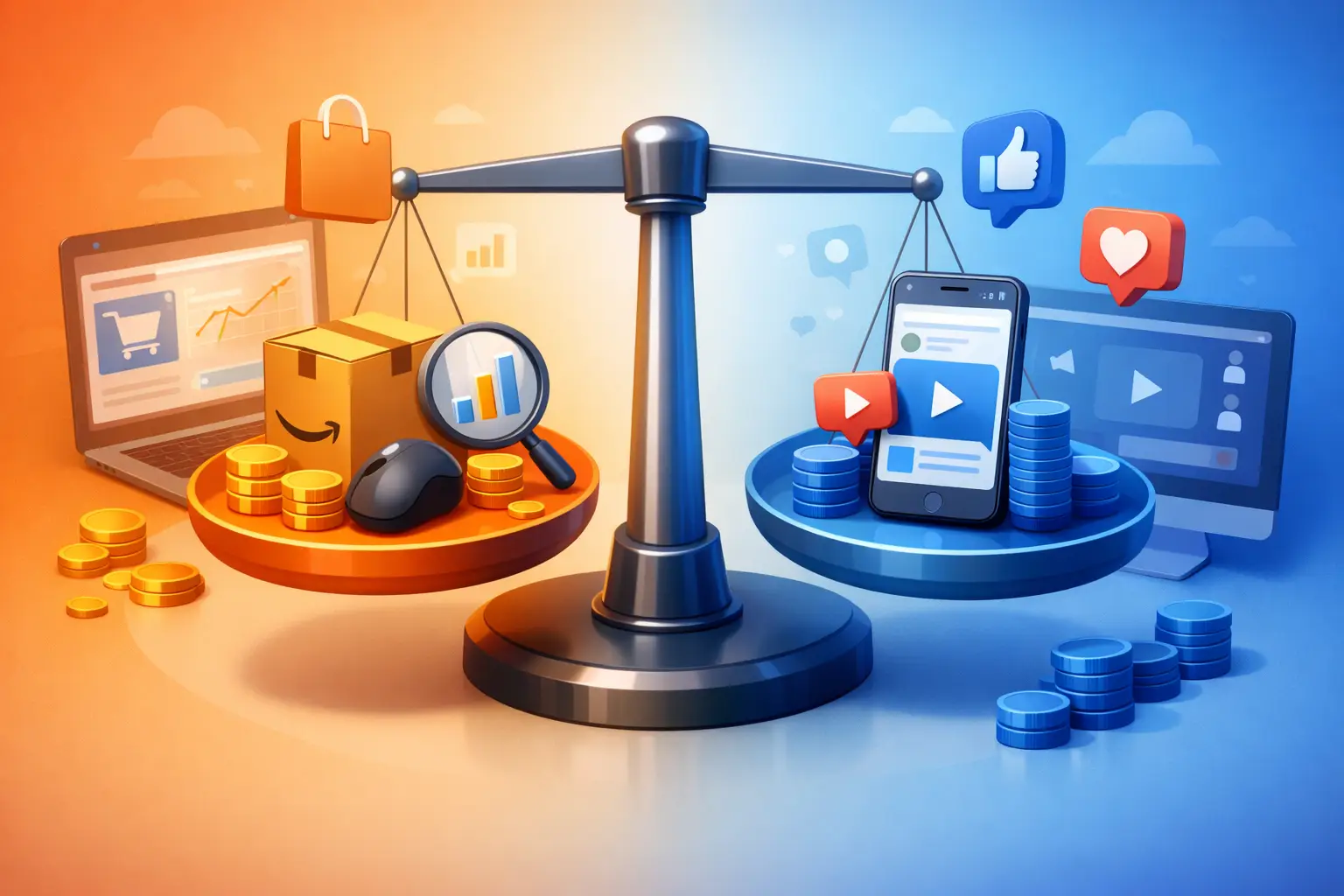
If your brand sells on Amazon and through its own site, the amazon ppc vs facebook ads question is not academic. It affects margin, stock planning, CAC, repeat purchase rate and how fast you can scale without burning cash. Treat it as a platform choice and you will cap growth. Treat it as a profit model and the right answer becomes much clearer.
For most ecommerce brands, Amazon PPC and Facebook Ads do different jobs. One captures demand close to purchase. The other creates and amplifies demand before a shopper is actively searching. That distinction matters because high-intent traffic usually converts better, while interruption-based traffic can scale awareness and new customer acquisition faster. The problem starts when brands judge both channels by the same KPI.
Amazon PPC is built for conversion efficiency inside a marketplace where shoppers already have buying intent. They are searching products, comparing prices, checking reviews and deciding whether to purchase now. You are paying to win visibility at the point where demand already exists.
Facebook Ads works further up the funnel. You are targeting audiences based on interests, behaviours, lookalikes and retargeting pools, then asking them to stop scrolling and care. That means Facebook can generate demand, shape perception and feed future purchases, but it usually requires stronger creative, better landing pages and tighter follow-up.
This is why a straight amazon ppc vs facebook ads comparison often misleads founders and ecommerce managers. Amazon usually wins on immediate conversion rate. Facebook often wins on audience expansion and new customer reach. If your reporting ignores what happens before and after the click, you will back the wrong platform.
If your product already has demand, Amazon PPC is usually the faster route to attributable revenue. Sponsored Products, Sponsored Brands and Sponsored Display let you intercept shoppers when they are close to checkout. In practical terms, that means shorter paths to purchase, cleaner conversion signals and less friction.
This channel tends to work especially well when you have strong reviews, competitive pricing, healthy stock levels and listings that are built to convert. If those basics are in place, paid traffic can compound quickly because the ad click lands in an environment designed for buying.
Amazon PPC also gives you a valuable layer of keyword intelligence. You can see what shoppers are searching for, where your product ranks and which terms convert at a profitable ACoS or TACoS. For brands focused on demand capture, this is commercial gold.
But Amazon has limits. You do not own the customer relationship in the same way you do on your DTC site. Brand building is weaker. Creative control is narrower. And if your category is crowded, CPCs can rise fast while retail readiness becomes the deciding factor. Bad stock management, weak reviews or poor listing content will choke performance no matter how good the campaigns are.
Facebook Ads earns its place when your goal is to create demand, launch products, expand into colder audiences or improve customer lifetime value through stronger first-party data capture on your own site. It is not just a traffic source. It is a demand-generation engine.
This matters for brands with products that need explanation, differentiation or emotional positioning. If you sell something visually compelling, solve a clear pain point or have a story that resonates, Meta can scale faster than Amazon because you are not waiting for shoppers to type the right keyword. You are putting the offer in front of them.
Facebook also gives you more control over the customer journey. You own the landing page, the email capture, the upsell flow and the retention system. If your DTC economics are solid, that control can outweigh a weaker first-click ROAS because the real return shows up over multiple purchases.
The trade-off is obvious. Facebook traffic is colder. Creative fatigue is real. Attribution is less tidy. Performance can swing harder if the account structure, offer and post-click experience are not aligned. Brands that rely on Meta without a disciplined testing process usually end up blaming the platform for problems caused by weak messaging or poor onsite conversion.
A lower CPC does not automatically mean cheaper acquisition. A better ROAS does not automatically mean better growth. The only comparison that matters is profitable revenue after channel-specific costs and operational realities.
Amazon often looks stronger because conversion rates are higher and the purchase intent is obvious. But marketplace fees, competitive pricing pressure and limited customer ownership reduce the real margin picture. Facebook can look weaker on front-end ROAS while still producing better long-term value if customers reorder, subscribe or buy higher-margin bundles on your site.
This is where many hybrid brands make a costly mistake. They scale Amazon because it is easier to attribute, then underinvest in Facebook because the path to conversion is less direct. The result is efficient demand capture with no serious engine for demand creation. Eventually growth plateaus because you are competing for the same in-market shoppers rather than expanding your addressable audience.
If you are early-stage, cash-sensitive and need revenue with clearer attribution, Amazon PPC is often the safer first move, especially if you already have marketplace traction. It gives faster feedback and usually requires less persuasion to convert.
If you are a more established brand with a credible DTC site, strong creative assets and repeat-purchase potential, Facebook can become the bigger growth lever. It can reach net-new audiences at scale and strengthen your brand equity at the same time.
For hybrid brands, the answer is rarely either-or. Amazon captures active shoppers. Facebook fills the pipeline with future buyers and retargets site visitors who are not ready on first touch. Used properly, one channel supports the other.
The real commercial issue is not amazon ppc vs facebook ads. It is what happens when each channel is managed in isolation.
If your Facebook campaigns are driving branded search and Amazon product discovery, but your team only reports last-click DTC sales, Meta will look weaker than it really is. If Amazon PPC is converting shoppers first exposed to your brand on Facebook, but no one is connecting those touchpoints, you will over-credit Amazon and underfund the top of funnel.
This is exactly why disconnected media buying wastes budget. One platform creates intent, another captures it, and a third closes the sale. If each is judged inside its own dashboard, you optimise for channel optics rather than total revenue.
For growth-minded brands, the smarter model is to align channels by job. Meta generates attention and audience growth. Google captures active search intent. Amazon converts marketplace demand. When those functions work together, the business gets more than isolated wins. It gets a system.
Start with the economics, not the platform preference. Look at your margin after fees, fulfilment and discounting. Check whether your product wins on Amazon because of real differentiation or simply temporary bid pressure. Review whether your DTC site can actually convert paid social traffic at a viable rate.
Then assess creative and operational readiness. Amazon needs strong listings, reviews and stock stability. Facebook needs sharp messaging, persuasive creative, fast landing pages and a retention plan. If the infrastructure is weak, more spend only magnifies inefficiency.
Finally, measure contribution beyond surface-level ROAS. Track branded search lift, halo effects on Amazon, returning customer revenue and blended MER. Senior teams that focus only on in-platform attribution usually underinvest in the channels that create future demand.
For many brands, the right move is not shifting budget entirely from one to the other. It is tightening Amazon for efficient conversion while using Facebook more deliberately to feed qualified traffic, test angles and expand the pool of eventual buyers. That is where integrated paid media starts producing compounding returns.
A specialist partner such as Accendo360 looks at this through one lens only: where the next pound of spend produces the strongest profitable growth across the whole business, not just inside one ad account.
If you are still forcing a winner in the Amazon PPC versus Facebook Ads debate, step back and look at the buying journey your customers actually take. The channel that looks best in isolation is not always the one building the strongest business.